A child can move from one grade to the next without mastering the skills they need to keep learning.
Being in school does not always mean a child is learning.
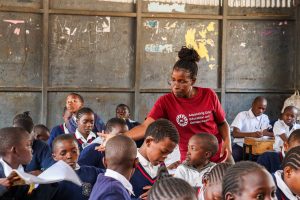
A learner can progress from one grade to the next while still struggling with foundational literacy or numeracy skills. Over time, those gaps can become bigger barriers making it increasingly difficult for learners to engage confidently with new concepts and continue progressing.
The challenge is bigger than any one classroom or school; UNICEF Kenya’s 2024 Annual Report reported that the proportion of Grade 3 learners reaching minimum proficiency in numeracy fell from 68.8% in 2019 to 54.2% in 2022.
We are seeing this challenge in our own work too through our Foundational Literacy and Numeracy assessments that found 21.5% of the assessed learners were still at the Beginner and Letter levels in literacy. So we started asking a different question: What if we taught where learners actually are, not simply the grade they are in?
But what did this look like in practice?
To explore how Teaching at the Right Level could respond to the different learning needs we were seeing, We piloted the approach across three counties. The pilot brought together Fellows, partner schools and learners to test whether teaching from a learner’s actual level of understanding could help strengthen foundational literacy and numeracy skills.
Here is what the pilot looked like:
Our TaRL Pilot at a Glance
- 23-Partner schools
- 39-Teach For Kenya Fellows
- 1,018-Grade 3 and Grade 4 learners
- 73.4%-Progressed by at least one learning level in literacy by Cycle 2
- 80.7%-Progressed by at least one learning level in numeracy by Cycle 2
That question led us to Teaching at the Right Level (TaRL); first understanding what a learner knows, then teaching from there.
TaRL was pioneered by Pratham, an Indian education organisation, and has been researched, adapted and implemented across different contexts for more than two decades. J-PAL’s research on Teaching at the Right Level has documented how targeted instruction can help address significant differences in learning levels within the same classroom.The underlying idea is simple; when children in the same classroom have very different learning levels, teaching everyone in exactly the same way can leave some learners behind but starting with where the learner is can change that.
There is evidence from Kenya, too. A randomized study involving 121 primary schools in Kenya found that grouping learners according to their initial achievement levels improved learning outcomes, partly because it allowed teachers to tailor instruction more closely to learners’ needs.
But the research also points to another important lesson that an evidence-based intervention is only as strong as its implementation. The approach needs time, preparation, coaching and support around the educators delivering it.
That was something we wanted to understand in our own context.
 What We Tried
Through our TaRL pilot, We introduced the approach across 23 partner schools in Nairobi, Kisumu and Machakos.
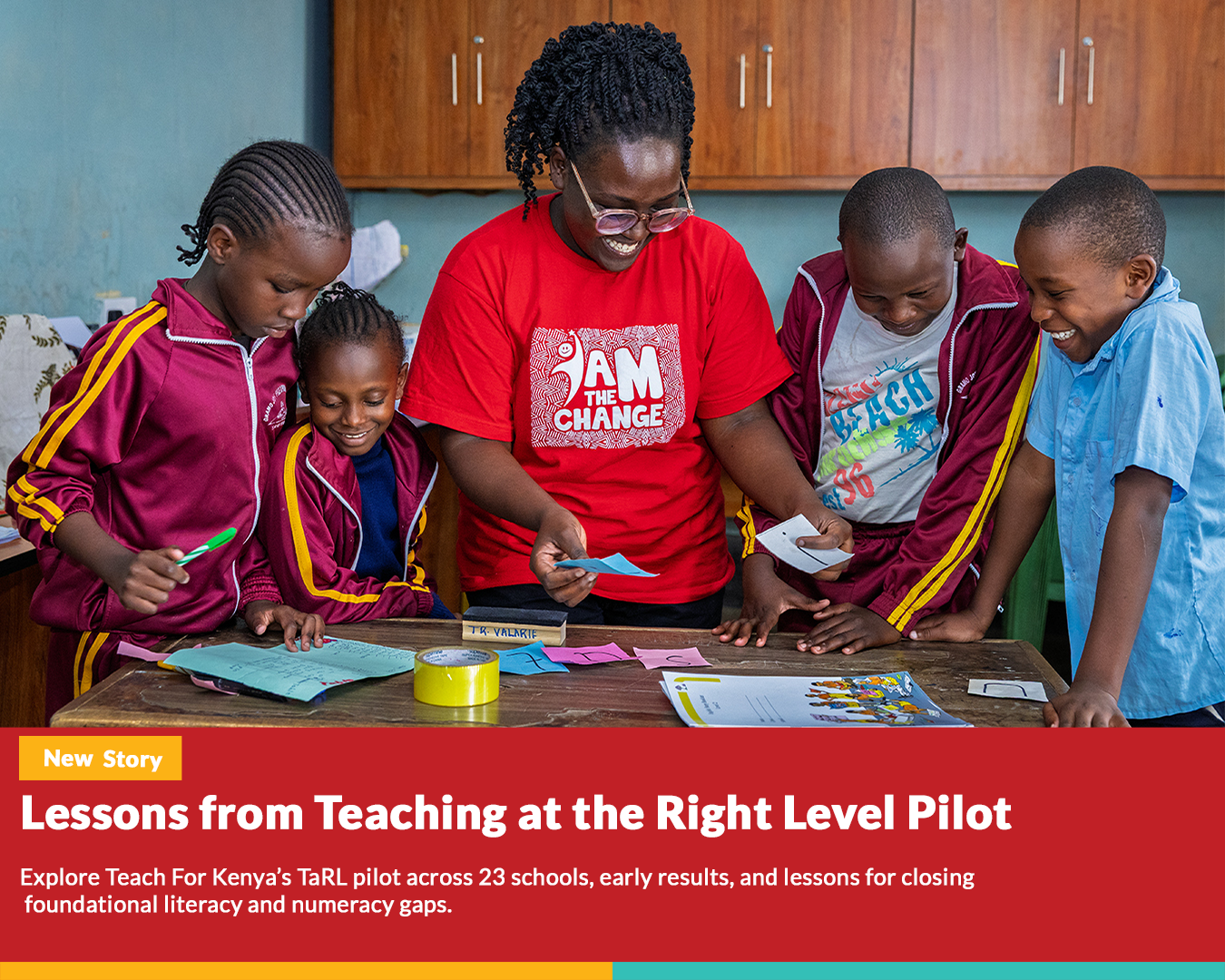
39 Fellows worked with 1,018 Grade 3 and Grade 4 learners and the process began with assessment. Fellows assessed learners’ foundational literacy and numeracy skills to understand what they already knew and what they needed next.
Learners were then grouped according to their demonstrated learning levels rather than simply being taught together because they were in the same grade.
From there, Fellows used targeted and engaging activities designed around the specific skills learners needed to develop. After each 10-day cycle, learners were assessed again allowing the Fellows to keep asking:
- What is this learner ready for now?
- Who needs more support?
- Who is ready to move on to the next level?
- What do we need to change in our teaching?For us, that is what makes TaRL more than a grouping strategy; it is a way of making teaching more responsive to learners.
What the Early Results Are Showing Us
By the end of Cycle two, 73.4% of participating learners had progressed by at least one learning level in literacy, while 80.7% had progressed by at least one learning level in numeracy.
These figures represent more than movement between learning levels. They suggest that many learners who may previously have struggled to access lessons at their grade level were beginning to build the foundational skills they needed to move forward.
For a learner, progressing by even one level can mean recognising letters they previously could not identify, reading words with greater confidence, understanding number concepts, or solving mathematical problems that once felt out of reach.
The results also reinforce an important idea behind TaRL: learners do not all start from the same place, and teaching that responds to their actual level of understanding can create more opportunities for them to participate, build confidence and make progress.
The pilot also recorded examples of learners making larger jumps, including movement of three or four learning levels in literacy and numeracy.
While these are early programme results not a causal impact evaluation they give us encouraging evidence to continue learning from and building on the approach.
What This Looked Like in the Classroom
The quantitative results show the extent of learner progression across the pilot. Wesley’s experience offers another perspective: what that change looked like within one classroom.
For Wesley Omondi, a Teach For Kenya Fellow at Migosi Comprehensive School, TaRL made it possible to better understand where his learners were and respond to their individual learning needs.
“My learners were lagging behind in Mathematics. Since introducing the TaRL tools, we have been able to assess and group learners according to their learning levels. This has helped us understand where each learner is and provide the right support. I had four learners who were significantly behind, but by the end of Cycle Two, they were able to solve mathematical problems that they had previously struggled with.”
— Wesley Omondi, Teach For Kenya Fellow, Migosi Comprehensive School

Wesley’s experience does not replace the broader data; it adds context to it. It illustrates how the core elements of the approach assessment, grouping and targeted support can translate into changes in teaching practice and learner experience.
Together, the quantitative and qualitative evidence helps us understand not only whether learners are progressing, but also how the intervention is being experienced and implemented in classrooms.
After Cycle one, 58.7% of learners in the literacy intervention showed positive change, while 61.8% showed positive change in numeracy.
By Cycle two, the results showed even greater movement.
73.4% of learners progressed by at least one learning level in literacy.
80.7% of learners progressed by at least one learning level in numeracy.
The pilot also recorded examples of learners making larger jumps, including movement of three or four learning levels up.
These numbers matter because they suggest that when instruction responds to learners’ demonstrated competency levels, meaningful progress can happen.But we are also careful about what the numbers do and do not tell us.
This is programme monitoring and early outcome evidence, not a causal impact evaluation.
The results are promising, but they are part of an ongoing learning process.
For us, impact is not just about finding positive numbers; it is also about understanding what those numbers are telling us and what they are not.
Impact Is Not Always a Straight Line
 Not every learner progressed; some learners remained at the same level, and a smaller proportion moved down a level.
That matters to us; if our goal is educational equity, the learners who are not progressing cannot become a footnote in the data.
They are often the learners who need us to understand the problem more deeply. The pilot also showed us that a strong instructional approach needs the right conditions around it.
Competing school activities affected instructional time, some learners were absent, fellows had to balance TaRL implementation with other responsibilities, preparation & training time were not always sufficient and stronger coaching and engagement with school leadership were needed in some settings.
An intervention can have a strong research base, but outcomes still depend on whether educators have the time, support, coaching and systems around them to implement it consistently.
So the question is not only if the approach works but also what do we need to put in place for it to work well, consistently and equitably?
What We’re Learning
One of the most valuable things about this pilot is that the learning is happening at two levels; we are learning about learners and we are learning about implementation.
The learner data are showing us where targeted support can help children move.
The implementation experience is showing us what Teachers/Fellows and schools need to deliver that support consistently.
So far, the pilot has pointed us towards several priorities:
- Stronger Teacher/Fellow preparation before implementation begins.
- Ongoing coaching and mentorship throughout the intervention.
- Better engagement with school leadership and other stakeholders.
- Protected instructional time for foundational learning activities.
- Closer attention to learner attendance.
- More individualized support for learners who are not progressing or who regress.
- We are also learning that implementation needs to be designed around the realities of schools not added on top of them without enough time, preparation or ownership.
For us, this is what it means to be a learning organisation; we test, we measure, we listen, we adapt and then we improve.
Where We Go From Here
The next step is not simply to do more TaRL but to do it better.
As we continue learning from the pilot, we are exploring how to strengthen the approach across the Fellow journey. This includes introducing TaRL earlier through Teach For Kenya’s Leadership Institute, -our initial training and development programme that prepares Fellows for their leadership and teaching journey then reinforcing their learning through continuous professional development and embedding support within routine coaching.
Sustainable impact is rarely about finding one intervention and applying it everywhere in exactly the same way; it is about understanding the problem, testing a response, listening to what the evidence tells you and continuously improving.
That is the journey we are on.
Why This Matters
At Teach For Kenya, we believe every child can learn.
But believing that every child can learn also means being willing to look closely at what happens when a child is not learning as expected.
It means asking better questions, using evidence rather than assumptions, listening to our Fellows, schools and learners, celebrating progress while paying attention to the learners who still need more.
The TaRL pilot is giving us an opportunity to do exactly that.
Educational equity is not only about getting children into classrooms; it is about making sure they have the opportunity to build the foundational skills that allow them to participate, progress and thrive.
And sometimes, moving learning forward starts with something simple: meeting the learner exactly where they are.
Continue Exploring Our Work
We are continuing to learn what it takes to strengthen foundational learning and expand educational opportunity for every child.
Explore Teach For Kenya’s Impact
Learn More About the Teach For Kenya Fellowship
Leave a Reply